Global Exchange
Designing a data-driven conversational support with AI experience
Launching and evolving a WhatsApp AI chatbot to reduce informational load on customer support.
Launching and evolving a WhatsApp AI chatbot to reduce informational load on customer support.
Launching and evolving a WhatsApp AI chatbot to reduce informational load on customer support.
From a guided MVP to a conversation-first model, iterated based on real usage data and feedback.
From a guided MVP to a conversation-first model, iterated based on real usage data and feedback.
From a guided MVP to a conversation-first model, iterated based on real usage data and feedback.
Global Exchange is the leading international foreign currency exchange company, headquartered in Spain and operating across 30+ countries worldwide.
This project focused on designing and launching a WhatsApp-based conversational agent to support customers with informational queries, while reducing operational load on the Customer Relationship Center (CRC) at a global scale.
The chatbot was intentionally launched as a live MVP and is currently evolving based on real usage data and user feedback across multiple markets.
Global Exchange is the leading international foreign currency exchange company, headquartered in Spain and operating across 30+ countries worldwide.
This project focused on designing and launching a WhatsApp-based conversational agent to support customers with informational queries, while reducing operational load on the Customer Relationship Center (CRC) at a global scale.
The chatbot was intentionally launched as a live MVP and is currently evolving based on real usage data and user feedback across multiple markets.
Global Exchange is the leading international foreign currency exchange company, headquartered in Spain and operating across 30+ countries worldwide.
This project focused on designing and launching a WhatsApp-based conversational agent to support customers with informational queries, while reducing operational load on the Customer Relationship Center (CRC) at a global scale.
The chatbot was intentionally launched as a live MVP and is currently evolving based on real usage data and user feedback across multiple markets.
Product
Product
Product
AI Conversational Agent (WhatsApp)
AI Conversational Agent (WhatsApp)
AI Conversational Agent (WhatsApp)
Skills
Skills
Skills
Product strategy
Conversation design
UX writing
Stakeholder management
Data-informed iteration
Product strategy
Conversation design
UX writing
Stakeholder management
Data-informed iteration
Product strategy
Conversation design
UX writing
Stakeholder management
Data-informed iteration
Role
Role
Role
Product Designer (Conversation & UX Lead)
Product Designer (Conversation & UX Lead)
Product Designer (Conversation & UX Lead)
The challenge
The Customer Relationship Center (CRC) was receiving a high volume of non-commercial inquiries, primarily related to office locations, opening hours, available services, and frequently asked questions.
Although these interactions were informational in nature, they required human intervention, generating operational overhead and limiting the team’s capacity to focus on higher-value, commercial requests.
The challenge was to design a scalable conversational experience capable of resolving informational needs efficiently, while remaining compliant, reliable, and seamlessly integrated with human support across multiple markets.
The Customer Relationship Center (CRC) was receiving a high volume of non-commercial inquiries, primarily related to office locations, opening hours, available services, and frequently asked questions.
Although these interactions were informational in nature, they required human intervention, generating operational overhead and limiting the team’s capacity to focus on higher-value, commercial requests.
The challenge was to design a scalable conversational experience capable of resolving informational needs efficiently, while remaining compliant, reliable, and seamlessly integrated with human support across multiple markets.
The Customer Relationship Center (CRC) was receiving a high volume of non-commercial inquiries, primarily related to office locations, opening hours, available services, and frequently asked questions.
Although these interactions were informational in nature, they required human intervention, generating operational overhead and limiting the team’s capacity to focus on higher-value, commercial requests.
The challenge was to design a scalable conversational experience capable of resolving informational needs efficiently, while remaining compliant, reliable, and seamlessly integrated with human support across multiple markets.
Product goals
Reduce operational load on support
The primary goal was to reduce informational load on the Customer Relationship Center (CRC) by handling repetitive, non-commercial inquiries through a conversational channel.
Offer always-available customer support
Validate WhatsApp as a support channel
Learn before enabling transactions
Scope & constraints
Scope & constraints
Scope & constraints
Defining a clear MVP scope was essential to balance speed, risk, and learning in a regulated fintech environment.
Defining a clear MVP scope was essential to balance speed, risk, and learning in a regulated fintech environment.
Definir un alcance claro del MVP fue clave para equilibrar velocidad, riesgo y aprendizaje en un entorno fintech regulado.
By explicitly setting what was included and what was intentionally out of scope, the project avoided premature complexity and allowed the team to focus on shipping, validating assumptions, and iterating based on real usage.
By explicitly setting what was included and what was intentionally out of scope, the project avoided premature complexity and allowed the team to focus on shipping, validating assumptions, and iterating based on real usage.
By explicitly setting what was included and what was intentionally out of scope, the project avoided premature complexity and allowed the team to focus on shipping, validating assumptions, and iterating based on real usage.
Define MVP scope
Define MVP scope
Define MVP scope
The initial release focused on a clearly defined informational scope, allowing the team to ship safely and learn from real usage.
The initial release focused on a clearly defined informational scope, allowing the team to ship safely and learn from real usage.
The MVP included:
Office locations and opening hours
FAQ, services, and available currencies
Language and country selection
Escalation to human agents when required
The MVP included:
Office locations and opening hours
FAQ, services, and available currencies
Language and country selection
Escalation to human agents when required
Explicity out of scope (by design)
Explicity out of scope (by design)
Explicity out of scope (by design)
Several features were intentionally excluded from the MVP to avoid premature complexity and risk:
Several features were intentionally excluded from the MVP to avoid premature complexity and risk:
Exchange rates
Order creation
Order tracking
Internal API integrations
Exchange rates
Order creation
Order tracking
Internal API integrations
These decisions helped keep the initial product focused, compliant, and manageable, while leaving room for future iterations.
These decisions helped keep the initial product focused, compliant, and manageable, while leaving room for future iterations.
Regulatory and platform constraints
Regulatory and platform constraints
Regulatory and platform constraints
Designing a conversational product in a fintech context introduced non-negotiable constraints:
Designing a conversational product in a fintech context introduced non-negotiable constraints:
Compliance requirements, including mandatory legal copy and explicit user consent
WhatsApp platform limitations, affecting interaction patterns and UI possibilities
Compliance requirements, including mandatory legal copy and explicit user consent
WhatsApp platform limitations, affecting interaction patterns and UI possibilities
These constraints directly shaped the conversation design and onboarding flow.
These constraints directly shaped the conversation design and onboarding flow.
Delivery & dependency constraints
Delivery & dependency constraints
Delivery & dependency constraints
The project also involved operational challenges:
The project also involved operational challenges:
Dependency on an external AI provider
Coordination with internal AI, customer support, and compliance teams
Underestimated delivery complexity, with a significant gap between initial estimates and actual execution time
Dependency on an external AI provider
Coordination with internal AI, customer support, and compliance teams
Underestimated delivery complexity, with a significant gap between initial estimates and actual execution time
Managing these constraints required continuous prioritization and cross-team alignment.
Managing these constraints required continuous prioritization and cross-team alignment.
Estrategia de UX y
diseño conversacional
La experiencia conversacional se diseñó para equilibrar flexibilidad y control, permitiendo a los usuarios obtener respuestas rápidas sin comprometer claridad, consistencia ni cumplimiento normativo en distintos mercados.
En lugar de buscar un chatbot abierto, el foco estuvo en diseñar un sistema conversacional fiable, capaz de guiar al usuario, gestionar expectativas y derivar a soporte humano cuando fuese necesario.
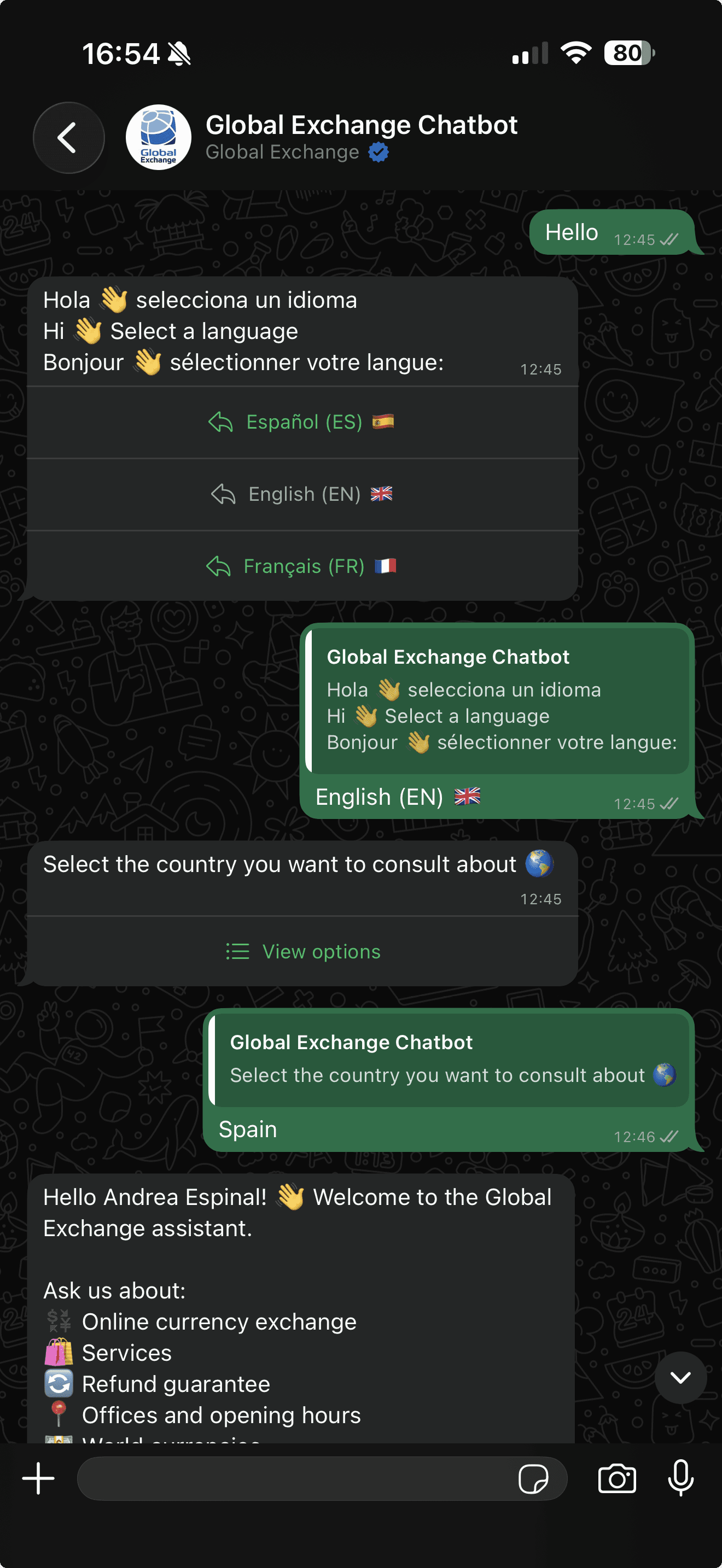
Guided entry for a regulated context
The initial MVP relied on a guided entry model to reduce ambiguity and risk.
By asking users to define language and country context upfront, the chatbot ensured accurate responses and compliance across multiple markets, while keeping the experience predictable and easy to follow.
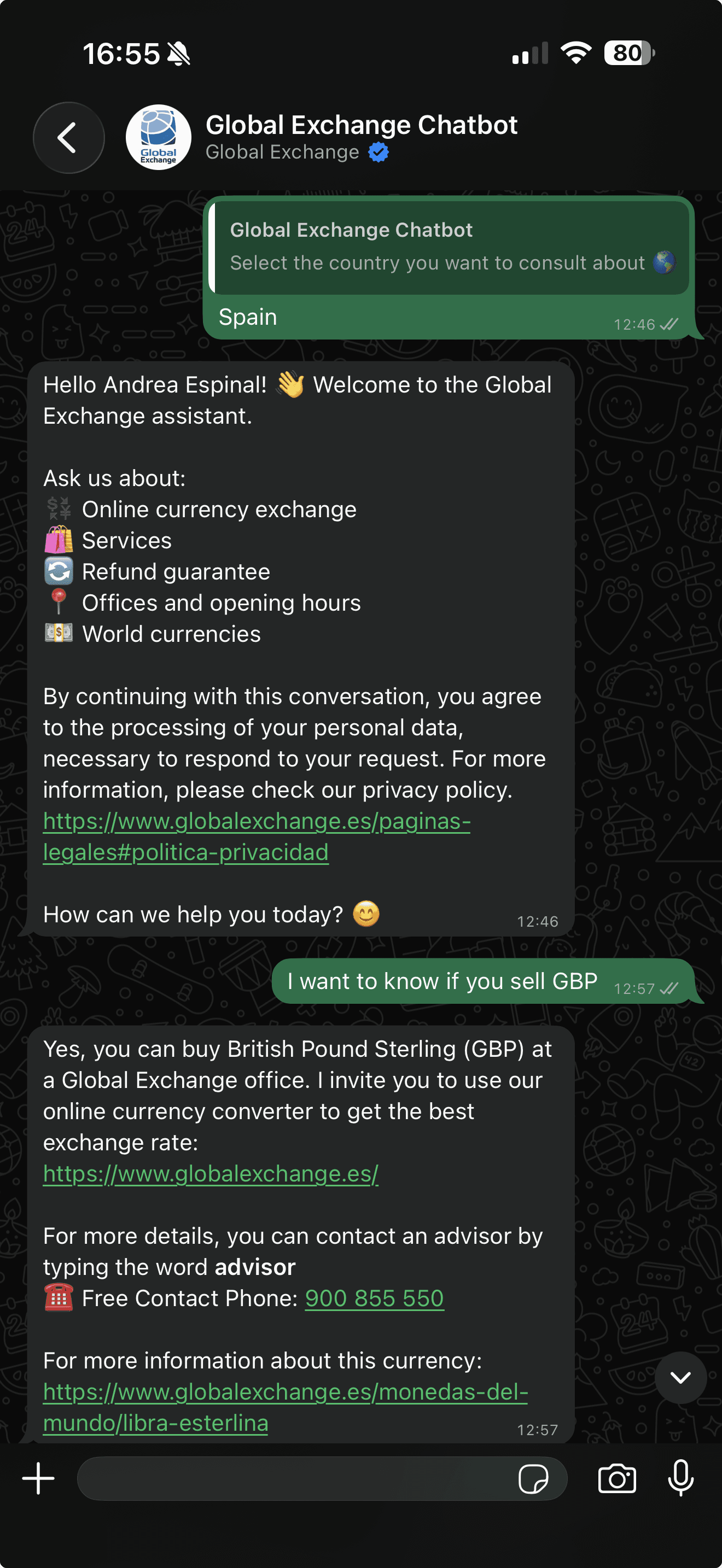
Design for intent, not free text
Instead of encouraging unrestricted conversation, the experience was designed around clear user intents and structured conversational paths.
This approach helped:
Minimize misunderstandings
Reduce error states
Set clear expectations about what the bot could and could not do
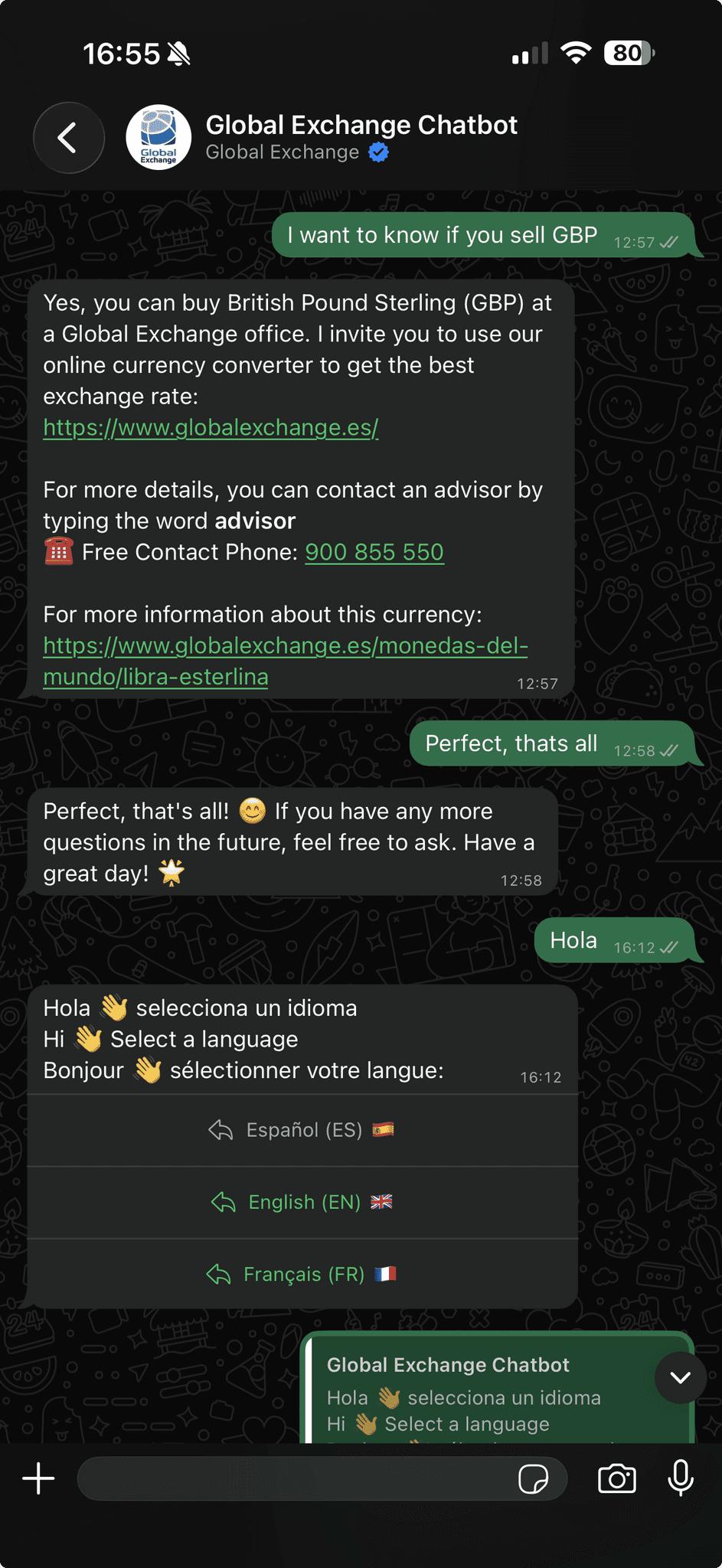
Human handoff as part of the experience
Escalation to the Customer Relationship Center (CRC) was treated as a designed outcome, not a failure.
Clear rules defined when to:
Attempt automated resolution
Prompt clarification
Connect users with a human agent
This ensured continuity between conversational support and human assistance.
Swipe
UX & conversation
design strategy
The conversational experience was designed to balance flexibility and control, ensuring users could get quick answers while maintaining clarity, consistency, and compliance across markets.
The conversational experience was designed to balance flexibility and control, ensuring users could get quick answers while maintaining clarity, consistency, and compliance across markets.
Rather than aiming for an open-ended chatbot, the focus was on designing a reliable conversational system that could guide users, manage expectations, and escalate to human support when needed.
Rather than aiming for an open-ended chatbot, the focus was on designing a reliable conversational system that could guide users, manage expectations, and escalate to human support when needed.
Guided entry for a regulated context
The initial MVP relied on a guided entry model to reduce ambiguity and risk.
By asking users to define language and country context upfront, the chatbot ensured accurate responses and compliance across multiple markets, while keeping the experience predictable and easy to follow.
Design for intent, not free text
Instead of encouraging unrestricted conversation, the experience was designed around clear user intents and structured conversational paths.
This approach helped:
Minimize misunderstandings
Reduce error states
Set clear expectations about what the bot could and could not do
Human handoff as part of the experience
Escalation to the Customer Relationship Center (CRC) was treated as a designed outcome, not a failure.
Clear rules defined when to:
Attempt automated resolution
Prompt clarification
Connect users with a human agent
This ensured continuity between conversational support and human assistance.
Guided entry for a regulated context
The initial MVP relied on a guided entry model to reduce ambiguity and risk.
By asking users to define language and country context upfront, the chatbot ensured accurate responses and compliance across multiple markets, while keeping the experience predictable and easy to follow.
Design for intent, not free text
Instead of encouraging unrestricted conversation, the experience was designed around clear user intents and structured conversational paths.
This approach helped:
Minimize misunderstandings
Reduce error states
Set clear expectations about what the bot could and could not do
Human handoff as part of the experience
Escalation to the Customer Relationship Center (CRC) was treated as a designed outcome, not a failure.
Clear rules defined when to:
Attempt automated resolution
Prompt clarification
Connect users with a human agent
This ensured continuity between conversational support and human assistance.
Swipe
Outcomes
The chatbot was launched as a live MVP, allowing the team to observe real customer behavior and assess the impact of conversational support throughout 2025.
The chatbot was launched as a live MVP, allowing the team to observe real customer behavior and assess the impact of conversational support throughout 2025.
The chatbot was launched as a live MVP, allowing the team to observe real customer behavior and assess the impact of conversational support throughout 2025.
2,883
2,883
2,883
Total conversations
through the chatbot
Total conversations
through the chatbot
Total conversations
through the chatbot
Driven by informational queries handled through conversational support channel during 2025
Driven by informational queries handled through conversational support channel during 2025
Driven by informational queries handled through conversational support channel during 2025
2,184
2,184
2,184
Auto-resolved conversations
Resolved in Spanish without requiring human intervention, reducing load on the Customer Relationship Center (CRC).
Resolved in Spanish without requiring human intervention, reducing load on the Customer Relationship Center (CRC).
Resolved in Spanish without requiring human intervention, reducing load on the Customer Relationship Center (CRC).
682
682
682
Conversations escalated to CRC
Transferred to human agents when queries exceeded the chatbot’s informational scope.
Transferred to human agents when queries exceeded the chatbot’s informational scope.
Transferred to human agents when queries exceeded the chatbot’s informational scope.
Product impact
Impacto en el
producto
The chatbot introduced a new first layer of customer support, reshaping how informational requests were handled across channels.
The chatbot introduced a new first layer of customer support, reshaping how informational requests were handled across channels.
The chatbot introduced a new first layer of customer support, reshaping how informational requests were handled across channels.
Impact points
Reduced operational load on the CRC by deflecting repetitive informational queries
Reduced operational load on the CRC by deflecting repetitive informational queries
Reduced operational load on the CRC by deflecting repetitive informational queries
Clear separation between informational support and human-assisted interactions
Clear separation between informational support and human-assisted interactions
Clear separation between informational support and human-assisted interactions
Validation of WhatsApp as a reliable, mobile-first support channel
Validation of WhatsApp as a reliable, mobile-first support channel
Validation of WhatsApp as a reliable, mobile-first support channel
Strong foundation for evolving the experience beyond the initial MVP
Strong foundation for evolving the experience beyond the initial MVP
Strong foundation for evolving the experience beyond the initial MVP
These outcomes confirmed that the initial MVP scope was effective, while also revealing clear opportunities to improve how users enter and navigate the conversation.
These outcomes confirmed that the initial MVP scope was effective, while also revealing clear opportunities to improve how users enter and navigate the conversation.
These outcomes confirmed that the initial MVP scope was effective, while also revealing clear opportunities to improve how users enter and navigate the conversation.
The next step was not to add more features, but to refine the conversational flow based on real usage patterns.
The next step was not to add more features, but to refine the conversational flow based on real usage patterns.
The next step was not to add more features, but to refine the conversational flow based on real usage patterns.
Data Drive interaction:
Flow 2.0
Insights from real usage data and customer feedback showed that the initial conversational flow, while effective, introduced unnecessary friction at the entry point.
Insights from real usage data and customer feedback showed that the initial conversational flow, while effective, introduced unnecessary friction at the entry point.
Rather than expanding functionality, the focus shifted to improving how users start and progress through the conversation.
Rather than expanding functionality, the focus shifted to improving how users start and progress through the conversation.
Rather than expanding functionality, the focus shifted to improving how users start and progress through the conversation.
What data revealed
Analysis of conversations highlighted consistent patterns:
Analysis of conversations highlighted consistent patterns:
Analysis of conversations highlighted consistent patterns:
Users preferred asking questions directly instead of navigating predefined options
Early structured choices slowed down first interactions
Many conversations followed similar informational paths, regardless of entry point
Users preferred asking questions directly instead of navigating predefined options
Early structured choices slowed down first interactions
Many conversations followed similar informational paths, regardless of entry point
Users preferred asking questions directly instead of navigating predefined options
Early structured choices slowed down first interactions
Many conversations followed similar informational paths, regardless of entry point
These insights made it clear that the issue was not what the chatbot offered, but how the conversation was initiated.
These insights made it clear that the issue was not what the chatbot offered, but how the conversation was initiated.
These insights made it clear that the issue was not what the chatbot offered, but how the conversation was initiated.
Key product decision
Based on these findings, I led the transition from a menu-driven entry to a conversation-first model.
Based on these findings, I led the transition from a menu-driven entry to a conversation-first model.
Based on these findings, I led the transition from a menu-driven entry to a conversation-first model.
The goal was to:
The goal was to:
The goal was to:
Reduce friction at the start of the conversation
Let users express intent naturally
Preserve control where compliance, handoff, and system logic required it
Reduce friction at the start of the conversation
Let users express intent naturally
Preserve control where compliance, handoff, and system logic required it
Reduce friction at the start of the conversation
Let users express intent naturally
Preserve control where compliance, handoff, and system logic required it
This decision defined the foundation for the next iteration of the conversational system.
This decision defined the foundation for the next iteration of the conversational system.
This decision defined the foundation for the next iteration of the conversational system.
Hybrid conversational
model
Flow 2.0 was designed as a hybrid conversational system, combining free user input with structured logic to balance flexibility, reliability, and compliance in a fintech environment.
Flow 2.0 was designed as a hybrid conversational system, combining free user input with structured logic to balance flexibility, reliability, and compliance in a fintech environment.
Flow 2.0 was designed as a hybrid conversational system, combining free user input with structured logic to balance flexibility, reliability, and compliance in a fintech environment.
The conversational structure was defined and validated before implementation, in close collaboration with internal teams and the AI provider.
The conversational structure was defined and validated before implementation, in close collaboration with internal teams and the AI provider.
The conversational structure was defined and validated before implementation, in close collaboration with internal teams and the AI provider.
How the hybrid model works
The model introduces a clear separation of responsibilities within the conversation:
Free text input as the default entry point, allowing users to start naturally
AI-led resolution for informational queries
Structured, rule-based logic reserved for:
Compliance and legal requirements
Inactivity handling
Surveys and conversation closure
Escalation to the Customer Relationship Center (CRC)
Free text input as the default entry point, allowing users to start naturally
AI-led resolution for informational queries
Structured, rule-based logic reserved for:
Compliance and legal requirements
Inactivity handling
Surveys and conversation closure
Escalation to the Customer Relationship Center (CRC)
Free text input as the default entry point, allowing users to start naturally
AI-led resolution for informational queries
Structured, rule-based logic reserved for:
Compliance and legal requirements
Inactivity handling
Surveys and conversation closure
Escalation to the Customer Relationship Center (CRC)
This approach ensures flexibility without sacrificing control, predictability, or consistency.
Why a hybrid approach
A fully open conversational model was neither necessary nor appropriate in this context.
The hybrid approach:
Reduces ambiguity without over-constraining users
Improves first-interaction speed and clarity
Maintains reliable behavior in regulated scenarios
Reduces ambiguity without over-constraining users
Improves first-interaction speed and clarity
Maintains reliable behavior in regulated scenarios
Reduces ambiguity without over-constraining users
Improves first-interaction speed and clarity
Maintains reliable behavior in regulated scenarios
It allows the chatbot to behave as a support assistant, not as a scripted menu or an uncontrolled chat interface.
Learnings & next steps
Learnings & next
steps
Learnings
Conversational entry points matter: reducing friction at the start had more impact than adding new features.
Guided freedom outperforms full openness in regulated environments.
Country and language context are critical for accuracy and trust in multi-market products.
Human handoff works best when designed as a first-class outcome, not as an exception.
Shipping a focused MVP enabled faster learning than waiting for full integrations.
Next steps
Let's talk
Crafted with care - fueled by curiosity and coffee
®2026 Andrea Espinal
Let's talk
Crafted with care - fueled by curiosity and coffee
®2026 Andrea Espinal